← All articles
Market
Why India’s mushroom demand is growing fast
Carver journal · 4 min read
3.19 lakh tIndia’s mushroom output in FY25
+79%Growth in output from FY21 to FY25
$507MProjected Indian market by 2034, up from $294M in 2025
Mushrooms used to be a niche item in Indian kitchens, mostly button mushrooms sold in a few big cities. That has changed quickly. India produced about 3.19 lakh tonnes of mushrooms in FY25, up from 1.78 lakh tonnes in FY21: a rise of 79% in four years.
Still a small share of the world
Worldwide, mushroom output reached about 51.6 million tonnes in 2024, and China grows roughly 94% of it. India is already the world’s third-largest producer by FAO figures, but that still amounts to less than 1% of global output. For a country of 1.4 billion people with a large vegetarian population, the room to grow is wide.
What is driving demand
- Health awareness. More families are looking for protein-rich vegetarian foods, and mushrooms fit easily into everyday dishes.
- Plant-based eating. Mushrooms give a meaty texture to vegetarian and vegan menus, from curries to burgers.
- Hotels and restaurants. Tourist cities like Jaipur have a large hospitality trade that needs a steady supply of fresh produce.
- Quick commerce and modern retail. Fast delivery apps and supermarkets now stock fresh and packaged mushrooms well beyond the metros.
- Government support. Central and state schemes, including Rajasthan’s 40% grant on production units, are bringing new growers into the sector.
Why local supply matters
Fresh mushrooms keep only 2–4 days. That makes long-distance supply expensive and wasteful, and it gives farms close to the buyer a clear advantage. Market researchers at IMARC Group expect India’s mushroom market to grow from about $294 million in 2025 to about $507 million by 2034, a 6.24% yearly growth rate. Farms near cities like Jaipur are well placed to serve that demand.
Talk to us about supply
Sources: IBEF via FreshPlaza (India output FY21–FY25); FAOSTAT 2024 via AtlasBig (world output and rankings); IMARC Group (market size, forecast and growth drivers).
← All articles
For landowners
Why mushroom farming suits small and idle land
Carver journal · 4 min read
Most crops need large fields, good rain and months of waiting. Mushrooms are different. They grow indoors, on shelves, in a room you control. That makes them one of the few farm businesses that can run on a small plot, an empty shed or even industrial land.
1. A small footprint
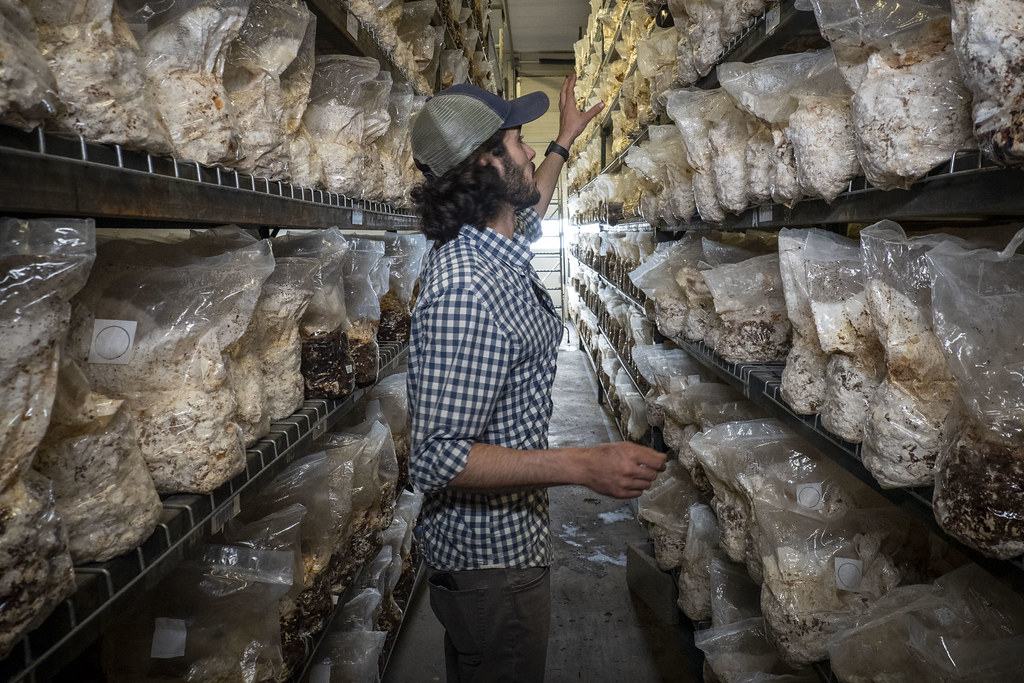
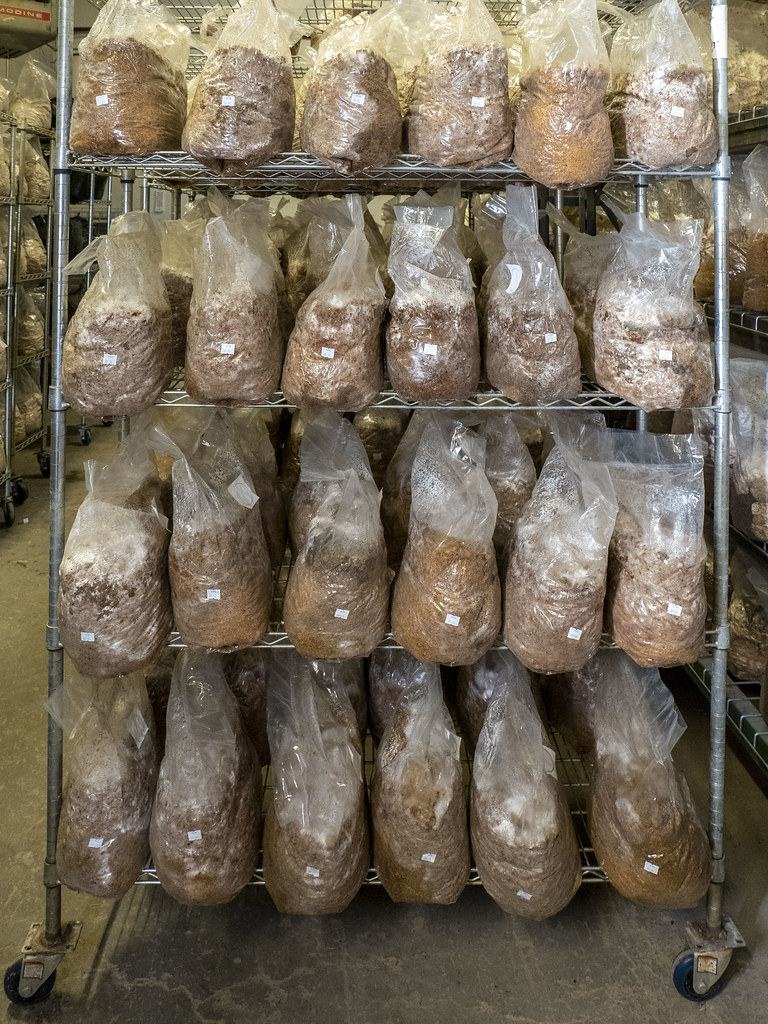
A Carver farm needs a plot of at least 33 × 40 ft or 18 × 55 ft: an 18 × 40 ft growing building with 15 ft of open space along one side. Mushrooms grow upwards on racks, so a small building holds thousands of bags.
2. No dependence on rain
Because the crop grows indoors, monsoon failures and hailstorms don’t touch it. Temperature and humidity are what matter, and those are managed inside the room.
3. Year-round output in Rajasthan’s climate
Button mushrooms like it cool. An insulated room with a 5.5-ton AC keeps the right temperature and humidity all year, so a farm can run six batches a year whatever the weather outside.
4. Built on farm waste
Button mushrooms grow on compost made mainly from wheat straw, which is plentiful across Rajasthan. Used compost can go back to fields as organic manure.
5. Quick cycles
Each batch takes about 60 days from filling the room to the last harvest. Compare that with fruit orchards that take years before the first crop.
6. Government support
Rajasthan’s horticulture department offers a 40% grant on mushroom production units, up to ₹8 lakh on a ₹20 lakh unit. Carver prepares the subsidy and loan paperwork with you.
Where most new growers go wrong
The hard parts are contamination, getting good compost and seed every cycle, and selling a crop that spoils in days. That is why Carver supplies the compost and seed, trains your workers, monitors the farm and buys back every kilo.
Check if your land qualifies
Subsidy terms are set by the Rajasthan Horticulture Department and can change; we confirm the current terms during your site visit.
← All articles
Nutrition
What’s inside a button mushroom
Carver journal · 3 min read
Button mushrooms are mostly water, which is why they are so light. What’s left is a useful mix of protein, fibre, B vitamins and minerals. Here is what 100 g of raw white button mushrooms contains, according to the US Department of Agriculture’s food database.
| Per 100 g, raw | Amount |
|---|
| Energy | 22 kcal |
| Protein | 3.1 g |
| Carbohydrate | 3.3 g |
| Dietary fibre | 1.0 g |
| Fat | 0.3 g |
| Niacin (vitamin B3) | 3.61 mg |
| Riboflavin (vitamin B2) | 0.40 mg |
| Pantothenic acid (vitamin B5) | 1.50 mg |
| Folate | 17 µg |
| Potassium | 318 mg |
| Selenium | 9.3 µg |
| Copper | 0.32 mg |
Light on calories, rich in B vitamins
At just 22 kcal per 100 g, button mushrooms add bulk and flavour to a meal with very few calories and almost no fat. They are a good source of riboflavin, niacin and pantothenic acid, B vitamins the body uses to turn food into energy, and they also supply selenium and copper.
Protein for vegetarian meals
Mushrooms are not as protein-dense as dal or paneer, but they add protein and a meaty texture to vegetarian dishes. Button mushrooms work well in mushroom matar, kadhai mushroom, biryani, soups and pizza.
The vitamin D trick
Button mushrooms grown in the dark contain very little vitamin D. But they make it when exposed to ultraviolet light, much as our skin does. Research reviewed in the journal Nutrients found that fresh button mushrooms left in midday sun for 15–120 minutes usually reached more than 10 µg of vitamin D per 100 g. A short spell of sunlight on sliced mushrooms before cooking is an easy way to get more from them.
Storing and cooking
Keep fresh button mushrooms in a paper bag in the fridge and use them within a few days. Pan-frying without much oil keeps most of their vitamin D; boiling loses more.
Order fresh mushrooms
Sources: USDA FoodData Central, “Mushrooms, white, raw” (SR Legacy 169251); Cardwell G. et al., “A Review of Mushrooms as a Potential Source of Dietary Vitamin D”, Nutrients, 2018. This article is general information, not medical or dietary advice.